
Hollow vs Solid Composite Decking
Quick answer: Hollow composite boards have channels running along their length, which makes them lighter, cheaper to buy and ship, and easier to handle. Solid boards are heavier and stronger, hold fixings better and suit commercial areas, docks and heavy loads. For most home decks, a quality hollow board on the correct joist spacing performs very well; choose solid where loads, traffic or impact are high.
Cut a composite deck board in half and you will see one of two things: a solid face of material, or a pattern of holes running through the board. Both are common, and both can be good products. The right choice depends on what the deck has to carry, how it will be used and, for importers, how the boards will be shipped.
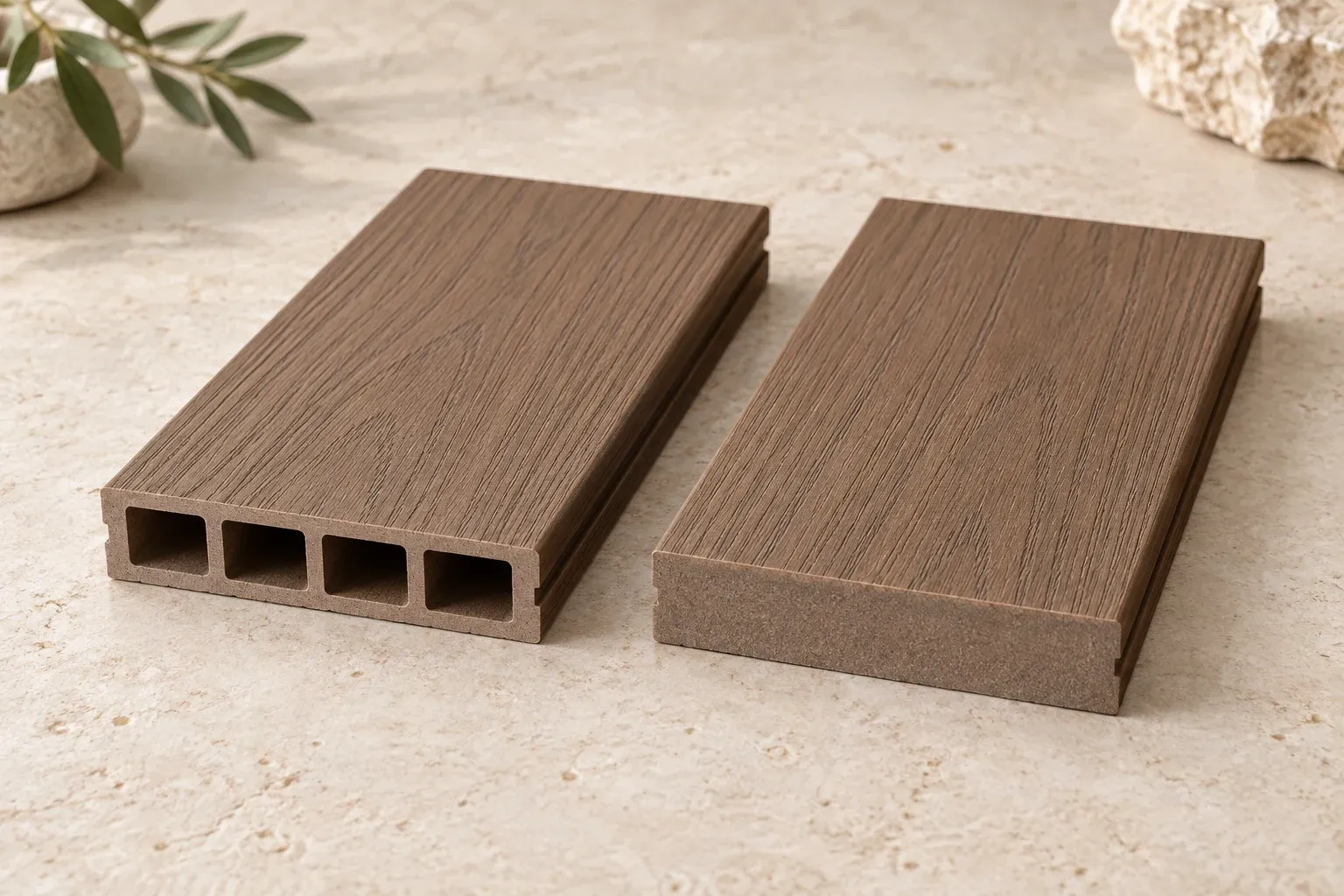
Hollow and solid boards can look the same from above; the difference is inside.
What Is a Hollow Composite Board?
A hollow board is extruded with channels inside, usually round or square holes running the full length of the board. The channels save material and weight while the outer walls and internal ribs carry the load, a little like a steel box section.
Hollow boards are most common in residential decking and in fencing, and they are usually grooved on both edges for hidden clips.
What Is a Solid Composite Board?
A solid board is extruded as one full section, with no internal channels. It is heavier and stiffer, and its cut ends look like solid timber. Solid boards are often used for commercial decks, public walkways, docks, stair treads and edge boards, and they can be grooved for clips or left plain for face screws.
Side-by-Side Comparison
| Hollow | Solid | |
|---|---|---|
| Weight | Lighter | Heavier |
| Material cost | Lower | Higher |
| Strength and stiffness | Good for residential loads | Higher; better for heavy loads |
| Joist spacing | Often closer | Can often span a little further (check the guide) |
| Impact resistance | Good | Better |
| Screw holding | Good with clips | Better, especially for face screws |
| Cut ends | Holes visible; need end caps or edge boards | Look solid; can be left exposed |
| Thermal movement | Moves with temperature | Moves with temperature; often slightly more in length |
| Shipping cost | Lower per square metre | Higher per square metre |
| Best for | Home decks, balconies, fencing | Commercial decks, docks, stairs, heavy furniture |
Strength and Load
Solid boards are stronger and stiffer than hollow boards of the same size. That matters where a deck carries crowds, heavy planters, catering equipment or frequent point loads such as table legs.
Hollow boards are designed with this in mind and perform well on residential decks when they are installed on the joist spacing the manufacturer specifies. Problems arise when hollow boards are laid on spans meant for solid boards or thick timber. Always use the figure in the installation guide; see our composite decking installation guide for typical spacing.
For hot tubs, large planters and other very heavy items, the substructure matters more than the board. These need an engineered base or their own slab, whichever board you choose.
Weight, Handling and Shipping
A hollow board can weigh noticeably less than a solid board of the same width and thickness. That brings three practical benefits:
- Lower material cost, because less raw material goes into each board
- Easier handling for installers, especially on upper floors and roof terraces
- Lower freight cost for importers, because containers of composite decking often reach their weight limit before they are full
The last point is important for distributors. A container of solid boards may carry fewer square metres than a container of hollow boards, which raises the landed cost per square metre.
Appearance and Finishing
From above, a hollow and a solid board with the same surface look identical. The difference shows at the ends:
- Hollow boards show their channels at cut ends, so ends are usually hidden with a picture-frame border, end caps or a fascia board.
- Solid boards can be left with cut ends visible, which is useful on stair treads, around pools and on open edges.
Many decks use both: hollow boards for the main surface and solid boards or edge boards on the borders and stairs.
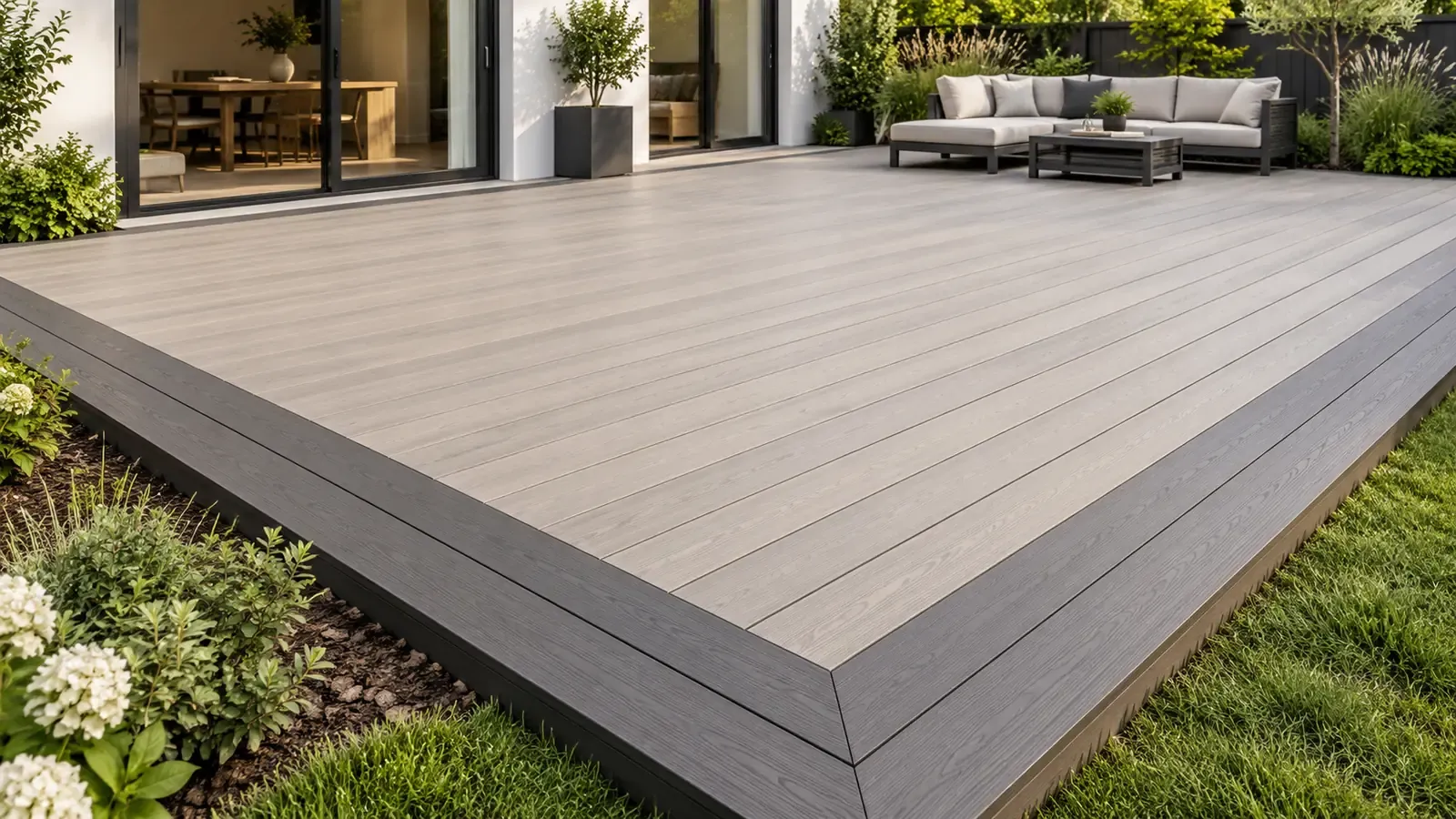
A common approach: hollow boards for the main area, solid boards for borders and stairs.
Heat and Expansion
Both types expand and contract with temperature, mainly along their length. Because a solid board contains more material, it can move slightly more in total and holds heat a little longer after sunset. Either way, follow the end-gap guidance for your board.
Colour has a bigger effect on surface temperature than the profile. For barefoot areas, choose lighter colours.
Hollow Board Shapes
Hollow profiles differ:
- Round holes spread stress evenly and are common in robust profiles.
- Square or rectangular holes save more weight but rely on well-designed internal ribs.
Both can be good. What matters is wall thickness, rib design and a dense, well-compounded material. Ask your supplier for the board weight per metre; very light boards for their size may have thin walls.

Round and square hollow profiles both work when walls and ribs are well designed.
Hollow vs Solid and Capping
The profile and the cap are separate choices. Both hollow and solid boards can be capped or uncapped. A capped hollow board is a popular choice for home decks because it combines low weight with a protective, easy-clean surface. Learn more in Co-extruded Decking Explained.
Which Should You Choose?
Choose hollow boards for:
- Home decks and garden terraces
- Balconies and roof terraces where weight matters (with suitable structure and waterproofing)
- Fencing and screens
- Projects where budget and freight cost are important
Choose solid boards for:
- Restaurants, hotels and public walkways
- Docks, jetties and boardwalks
- Stair treads and exposed edges
- Decks with heavy furniture, planters or frequent point loads
Still deciding between other options as well? Our composite decking buying guide covers the full set of choices.
Frequently Asked Questions
Is hollow composite decking any good?
Yes. Quality hollow boards perform well on residential decks when installed on the manufacturer’s joist spacing. They are lighter, cheaper and easier to ship and handle.
Is solid composite decking better than hollow?
It is stronger and better for heavy loads and commercial use, but it costs more and weighs more. For most home decks, hollow boards are the better value.
Can water get inside hollow decking?
The channels can collect some water at open ends. Covering ends with caps or edge boards, and laying the deck with a slight fall, helps water drain away.
Do hollow composite boards need closer joists?
Often, yes. Hollow boards usually need the closer end of the typical joist-spacing range. Always follow the installation guide for the specific board.
Why is solid composite decking more expensive?
It uses more raw material per metre and weighs more, which also raises freight costs.
Compare Profiles in Person
- Order samples of hollow and solid boards and compare the weight and cut ends.
- Browse our composite decking range.