
Co-extruded Decking Explained
Quick answer: Co-extruded decking is composite decking made with two extruders working at the same time: one forms the wood-plastic core, the other wraps it in a thin protective polymer shell, and both fuse in a single die. The shell carries extra UV stabilisers and pigments, so the board resists fading, stains and water better than uncapped WPC. Its performance depends on the cap formula, thickness and bond.
“Co-extruded”, “capped”, “second-generation” and “shielded” are all names for the same idea: a composite deck board with a protective skin. Co-extrusion is the most common way to make capped boards today, and it changed composite decking more than any development since the first WPC boards.
This guide explains the technology behind co-extruded decking: how it is made, what the cap is, why some caps last and others peel, and how to check a board before you buy. For a buyer-focused comparison of capped and uncapped boards, see Capped vs Uncapped Composite Decking.
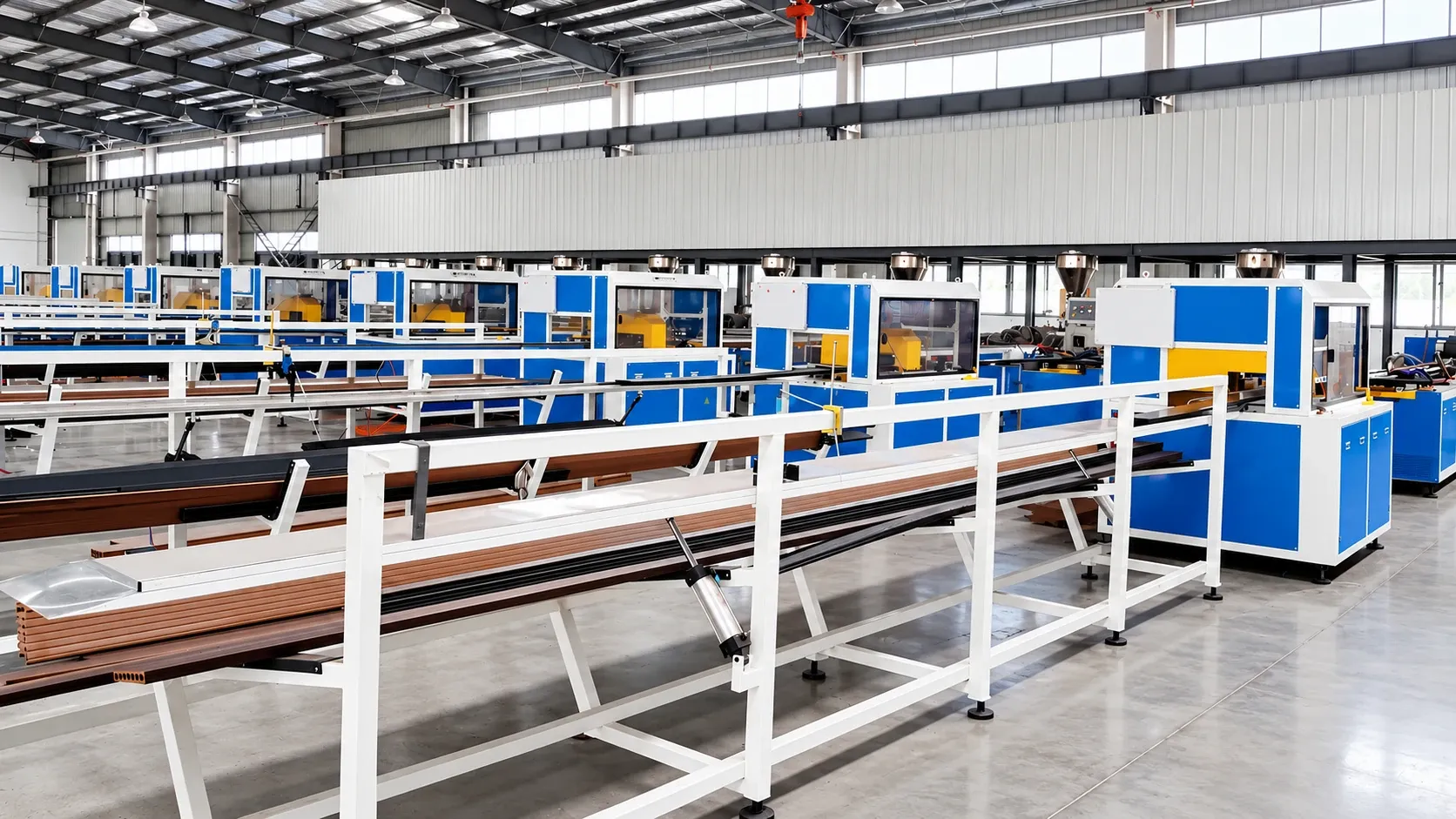
In co-extrusion, the core and the protective cap are formed together in one die.
How Co-extrusion Works
A standard (uncapped) WPC board comes from a single extruder: the compounded wood-plastic material is melted and pushed through a shaped die.
A co-extrusion line adds a second, smaller extruder. It melts the cap material and feeds it into the same die, where it flows around the core as both are shaped. When the board leaves the die, the core and the cap are already one piece.
The process in five steps:
- Core compounding. Dried wood fibre, plastic and additives are blended into uniform granules.
- Cap compounding. A separate polymer blend is prepared with concentrated UV stabilisers, pigments and other additives.
- Co-extrusion. Two extruders feed one die. The cap wraps the core while both are hot, so they fuse together.
- Calibration and cooling. The profile is sized and cooled on a water-cooled table.
- Surface finishing. The cap is embossed, brushed or grooved, then the boards are cut, checked and packed.
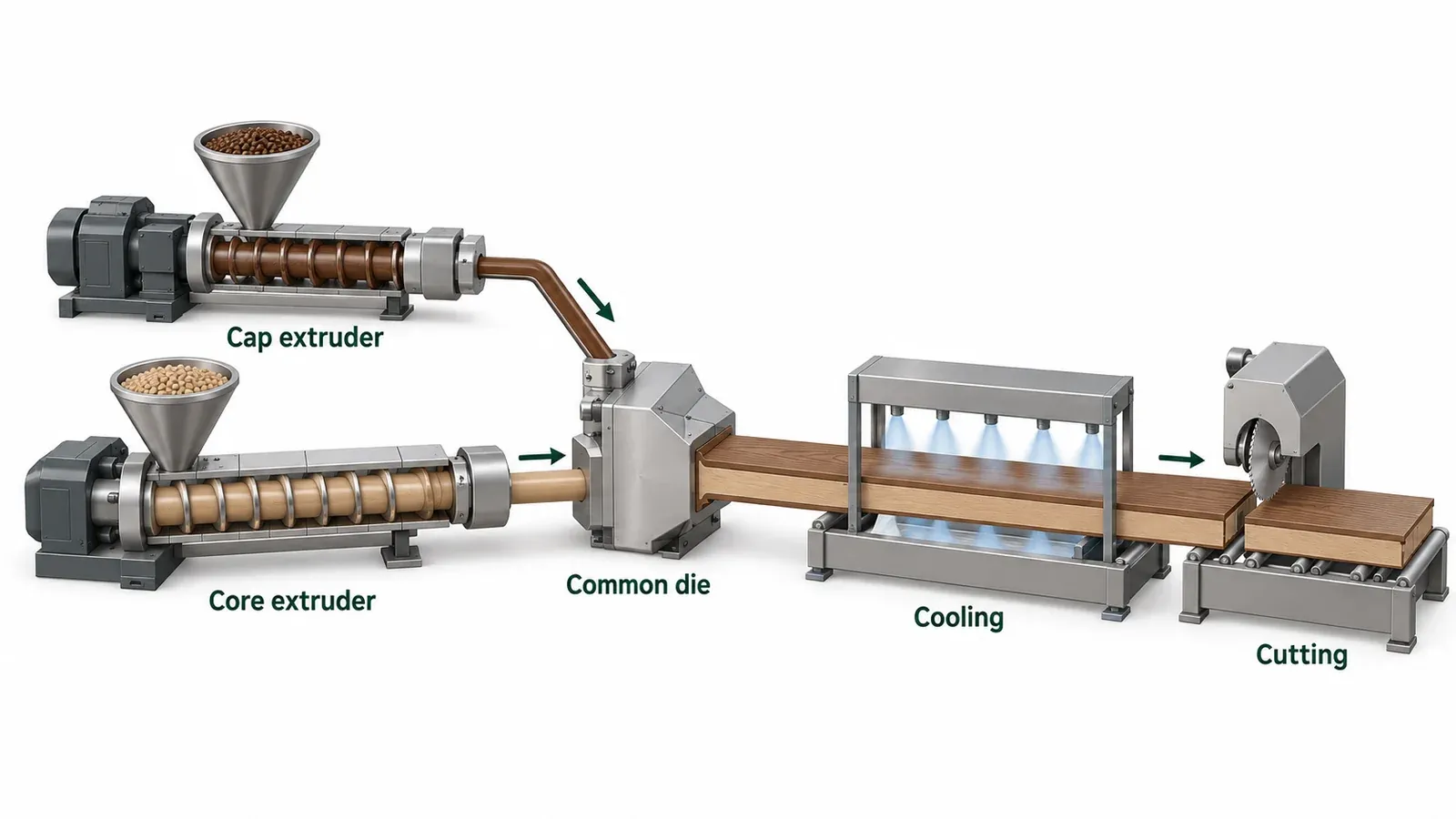
Two extruders, one die: the core and cap are shaped and fused in one pass.
What Is the Cap Made Of?
The cap is a polymer layer, usually based on polyethylene and modified for outdoor performance. Some manufacturers use other weather-resistant polymers such as ASA for specific product lines. Whatever the base, the cap formula concentrates what the surface needs:
- UV stabilisers to slow colour change
- Pigments, mainly inorganic, for stable outdoor colour
- Modifiers for scratch resistance and bonding to the core
Because these additives sit in a thin outer layer rather than throughout the whole board, the factory can use higher-grade ingredients at the surface without a large jump in cost.
3-Sided vs 360° Capping
| 3-sided capping | 360° (4-sided) capping | |
|---|---|---|
| Cap coverage | Top and both edges | All four sides |
| Underside | Exposed core | Capped |
| Water protection | Good from above | Highest, all round |
| Price | Lower | Higher |
| Best for | Most garden decks with good ventilation | Damp sites, low decks, pools, waterfronts |
Board ends are uncapped in both types, because they are cut on site. End caps or edge boards cover exposed ends where needed.

A 360° cap protects all four sides; a 3-sided cap leaves the underside uncapped.
Why Cap Thickness Matters
Cap thickness affects how long the surface lasts, but thicker is not automatically better.
- Too thin: the cap can wear through in high-traffic areas, and if the core absorbs water, pressure can burst a very thin shell.
- Too thick: the cap material shrinks and expands differently from the core. A heavy cap can pull the board out of shape as it cools or cycles through hot and cold.
- Balanced: most experienced manufacturers aim for roughly 0.5–1.0 mm, matched to the core formula.
What matters most is the combination of cap formula, thickness and bonding, controlled consistently on every batch.
Why Some Caps Peel
Cap delamination is the most serious defect in co-extruded boards. It has two main causes:
- Poor production control. Co-extrusion needs precise formulas, temperatures and line speeds. A factory that runs the line too fast or cuts corners on the bonding agents produces a weak bond.
- Different movement between layers. The cap and core expand and contract at different rates. If the bond is weak, years of hot days and cold nights slowly pull the cap loose.
Early co-extruded products suffered from both problems. As the technology matured, well-controlled caps have become far more reliable, and quality capped boards are now expected to last for decades.
How Manufacturers Test the Cap
Good factories test cap bonding on production samples, not just once for a certificate. A common stress test is a boiling and freezing cycle: samples are boiled for many hours, then frozen well below zero, and the cycle is repeated several times. The cap must show no blistering, cracking or separation afterwards.
Other routine checks include cap thickness measured at several points, colour against the master sample, surface hardness and scratch resistance, and water absorption.
See how we approach quality control on our manufacturing and quality page.

Boiling and freezing cycles show whether the cap stays bonded under stress.
What the Cap Makes Possible
Co-extrusion did more than protect boards. Because the cap is a separate layer, factories can:
- Create multi-tone and streaked colours that look closer to natural timber
- Emboss deeper wood grain, including 3D embossed textures
- Offer brighter or darker colours that would fade too quickly in uncapped boards
- Use different caps on the same core for different markets and price points
How to Check a Co-extruded Board
- Cut a sample. Look for an even cap of consistent thickness all the way round.
- Try to lift the cap at the cut edge with a fingernail or a thin blade. It should not peel.
- Check the core. It should be dense and even, without bubbles.
- Scratch test. Drag a key lightly across the surface and compare with other samples.
- Spill test. Leave a drop of oil or red wine on the surface for an hour, then wipe it off.
- Ask for evidence. Test reports, batch QC records and the written warranty.
Frequently Asked Questions
What is co-extruded decking?
Composite decking made with two extruders that form a wood-plastic core and a protective polymer cap at the same time, fused into one board.
Is co-extruded decking the same as capped decking?
Yes. Co-extrusion is the most common way to make capped composite decking, so the terms are usually used interchangeably.
How thick should the cap be on composite decking?
Most experienced manufacturers aim for roughly 0.5–1.0 mm. A cap that is too thin can wear or burst, and one that is too thick can make the board bend.
Can the cap on co-extruded decking come off?
On well-made boards it should not. Peeling usually results from poor production control or a poorly matched cap and core.
Is 360° capped decking better than 3-sided?
It offers more protection, especially on damp sites, low decks and around water. For well-ventilated garden decks, a quality 3-sided cap performs well at a lower price.
See the Cap for Yourself
- Order samples of our capped Shield Series and compare a cut cross-section.
- Explore the Shield Series decking.