
Composite Decking Buying Guide 2027
Quick answer: To choose composite decking, start with where the deck will be and how hard it will be used. Then decide between capped and uncapped boards, hollow and solid profiles, the board size, the colour and finish, and the substructure. Finish by checking test reports and the written warranty, and budget for the whole deck, not just the boards.
Composite decking has become the default choice for many new decks in Europe, North America and Australia. It does not rot, it does not splinter and it never needs staining. But the choice of boards is wide, and two products that look the same in a photo can perform very differently after a few summers.
This guide walks through the eight decisions that matter, in the order a good installer or distributor would make them. It is written from the factory side: we make WPC decking every day, and we will tell you where the real differences are and where they are not.
If you are new to the material itself, start with our guide to what WPC is and how it is made.
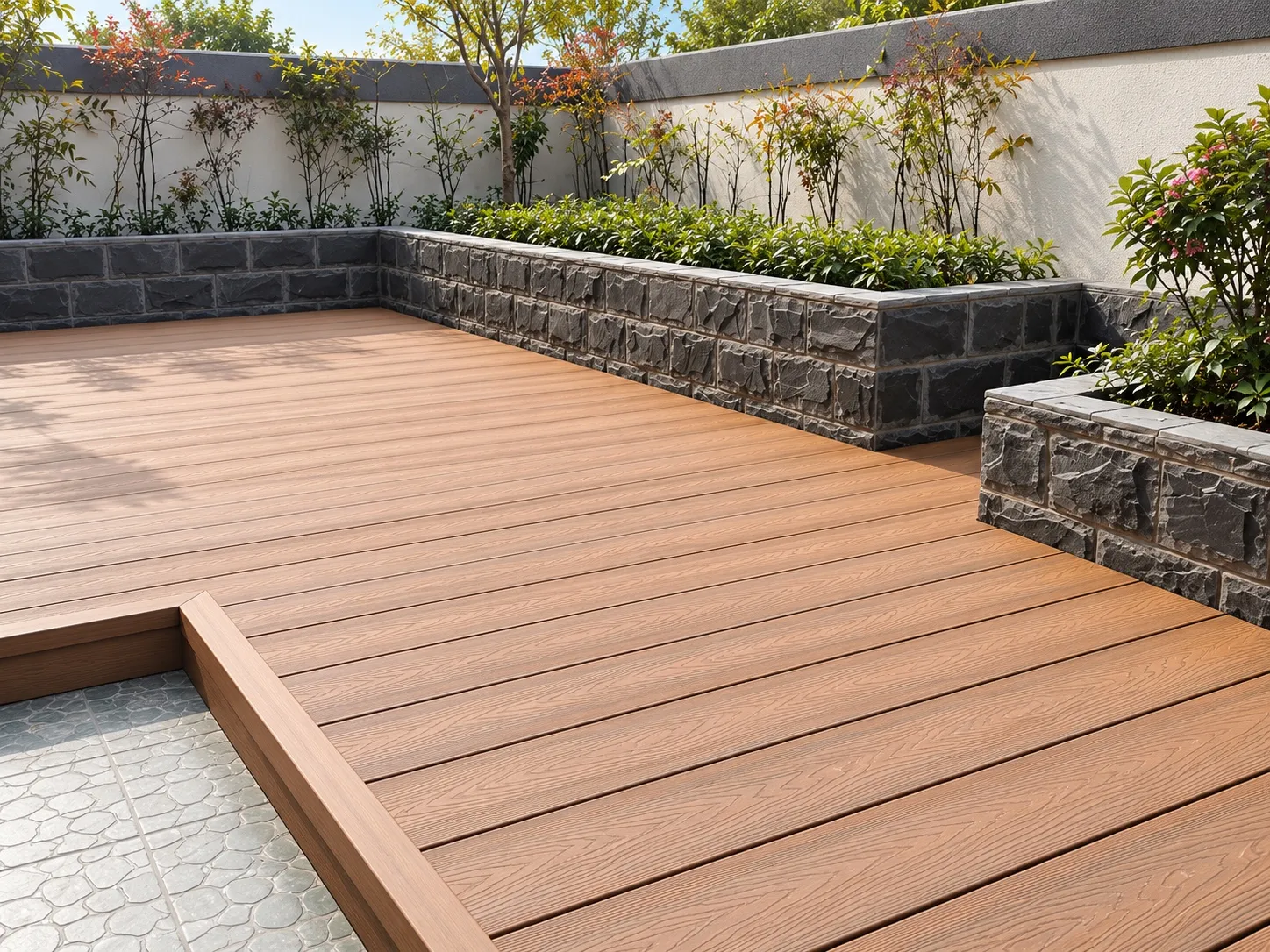
A well-planned composite deck starts with how the space will be used.
Step 1: Start With the Site, Not the Sample
The right board depends on the job it has to do. Before you look at colours, answer five questions about the site:
- How much direct sun does it get? Full sun all afternoon raises surface temperature and speeds up colour change. It favours capped boards and lighter colours.
- Is it near water? Pool surrounds, docks and lakeside decks need boards with low water absorption and good slip resistance.
- How shaded and damp is it? Decks under trees or on the north side of a building stay wet longer and collect leaves, so mould resistance and easy cleaning matter more.
- Who will use it, and how often? A family deck, a restaurant terrace and a hotel boardwalk are three very different loads.
- What is the local climate? Hot and humid, cold with freeze–thaw cycles, or coastal with salt air all affect which formula and profile make sense.
Write these answers down. Every later choice in this guide refers back to them.
Step 2: Capped or Uncapped Boards
This is the single biggest decision, because it decides how the board surface behaves.
Uncapped (first-generation) composite is one uniform material from surface to core. It has a natural, matte wood feel and costs less. Because wood fibre sits at the surface, it absorbs more water and oil, and its colour changes more in the first year before settling.
Capped (co-extruded) composite has a protective polymer shell bonded around the core. The shell carries extra UV stabilisers and pigments, so it holds its colour better, resists stains and is easier to clean. It costs more.
| Uncapped | Capped | |
|---|---|---|
| Surface | Wood fibre and polymer | Protective polymer shell |
| Look | Matte, natural wood feel | Sharper grain, wider colour range |
| Stain resistance | Moderate | High |
| First-year colour change | Noticeable, then settles | Much smaller |
| Cleaning | Needs more attention | Wash and wipe |
| Price | Lower | Higher |
| Best for | Shaded areas, budget projects, fencing | Sunny decks, pools, dining and high-traffic areas |
In our range, the Shield Series is capped, while the Natural Series (uncapped, deeper wood-grain character) and the Essential Series (practical first-generation WPC for value-focused projects) are uncapped. For a full comparison, read Capped vs Uncapped Composite Decking.
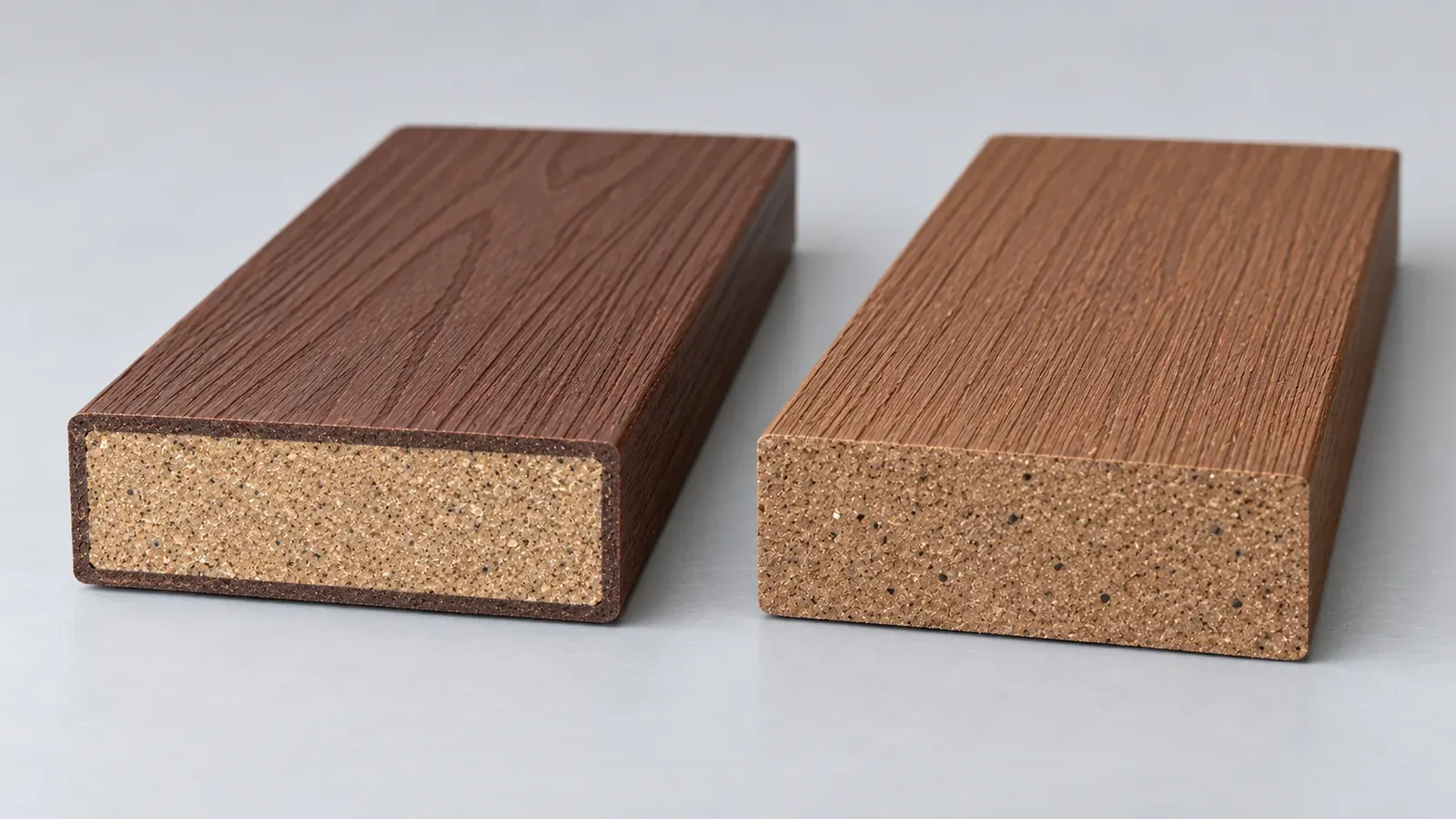
Capped boards (left) carry a protective shell; uncapped boards (right) are one material throughout.
Step 3: Hollow or Solid Profiles
Composite boards come in hollow profiles, with channels running along the board, and solid profiles.
- Hollow boards are lighter, cheaper to ship and quicker to handle. They suit most residential decks when installed on the right joist spacing.
- Solid boards are heavier and stronger, and they look like solid timber at cut ends. They suit commercial areas, public walkways, docks, and decks carrying heavy planters or hot tubs (with an engineered substructure).
A hollow board is not a lower-quality board. What matters is that the profile, the joist spacing and the load match. If a deck will see heavy point loads or crowds, choose solid boards and ask your supplier for the recommended spans.
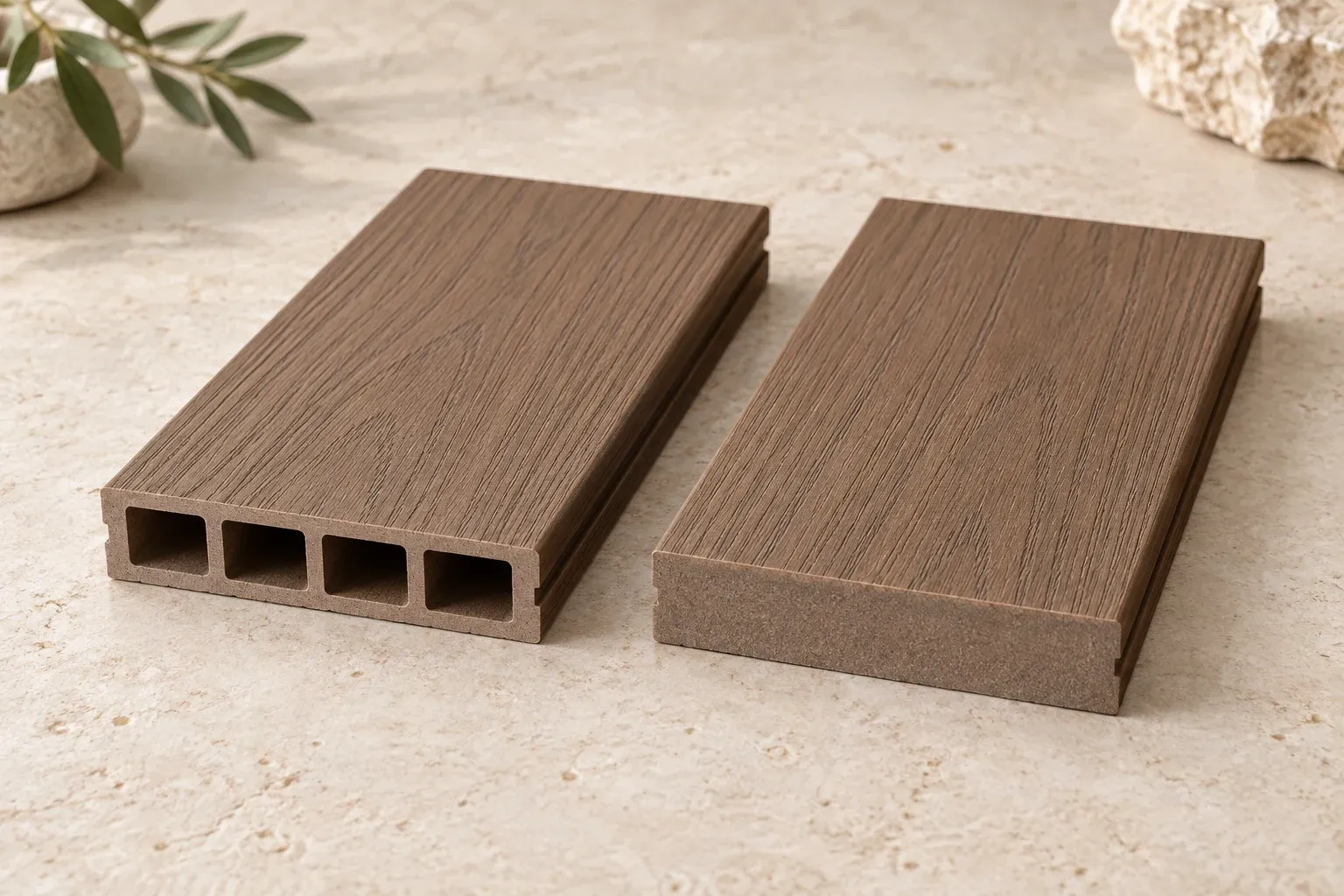
Hollow profiles save weight; solid profiles add strength for heavier use.
Step 4: Board Size and Length
Most composite deck boards on the market are around 135–150 mm (about 5.5 in) wide and 20–25 mm (about 1 in) thick. Some brands also offer wider boards of 200 mm or more for a modern, wide-plank look.
Length matters more than many buyers expect:
- Longer boards mean fewer joints. A 5.4 m deck finished in 5.4 m boards has no butt joints at all.
- Choose lengths that suit the deck dimensions. Cutting 4 m boards to fit a 3.1 m deck wastes almost a quarter of each board.
- Check shipping limits. Boards over about 5.8 m can be harder to handle and ship. For importers, standard lengths that fit a container efficiently keep freight cost down.
Ask whether boards are grooved on both edges (for hidden clips) or solid-edged (for face screws or edge boards), and whether matching edge and fascia boards are available in the same colour.
Step 5: Colour and Surface Finish
Choose colour with your eyes and your feet.
- Lighter colours stay cooler. In strong sun, darker boards get noticeably hotter than light greys and sands. For pool decks and barefoot areas, lean lighter.
- Darker colours show dust and pollen more, while mid-tones and mixed-tone boards hide everyday dirt best.
- Multi-tone and streaked colours look more natural and hide small scratches, while solid colours give a cleaner, modern look.
Finishes include brushed, sanded, fine-grooved, wood-grain embossed and deep 3D embossed grain. Deeper grain looks more like timber and adds grip; smoother finishes feel more contemporary.
Colour on a screen is never reliable. Order physical samples, and look at them outside in morning, midday and evening light. Our article on composite decking colour variation explains why the same colour can look different in different conditions. You can browse current options on our colours and finishes page.
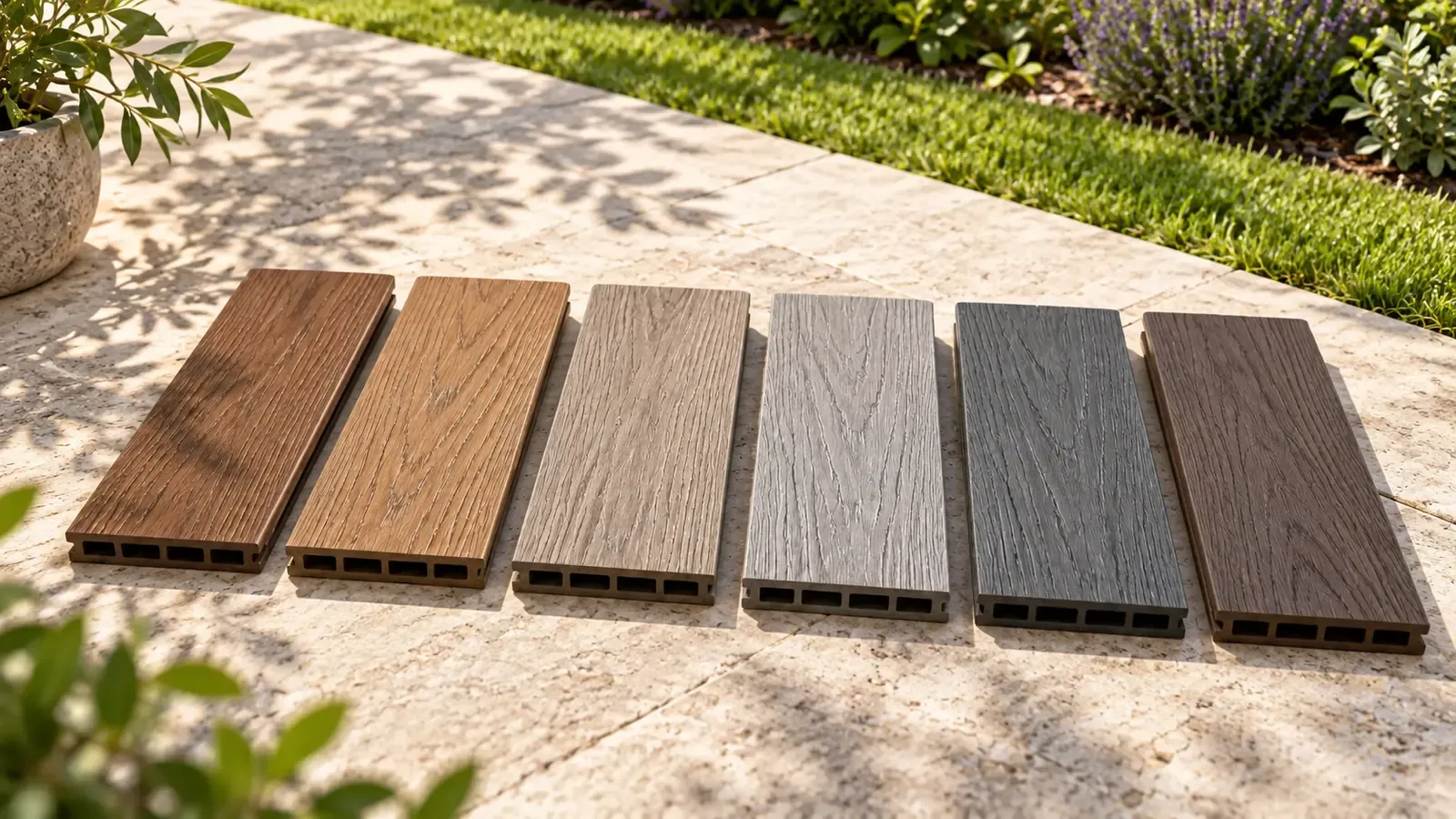
Always compare colour samples outdoors, in the light where the deck will be.
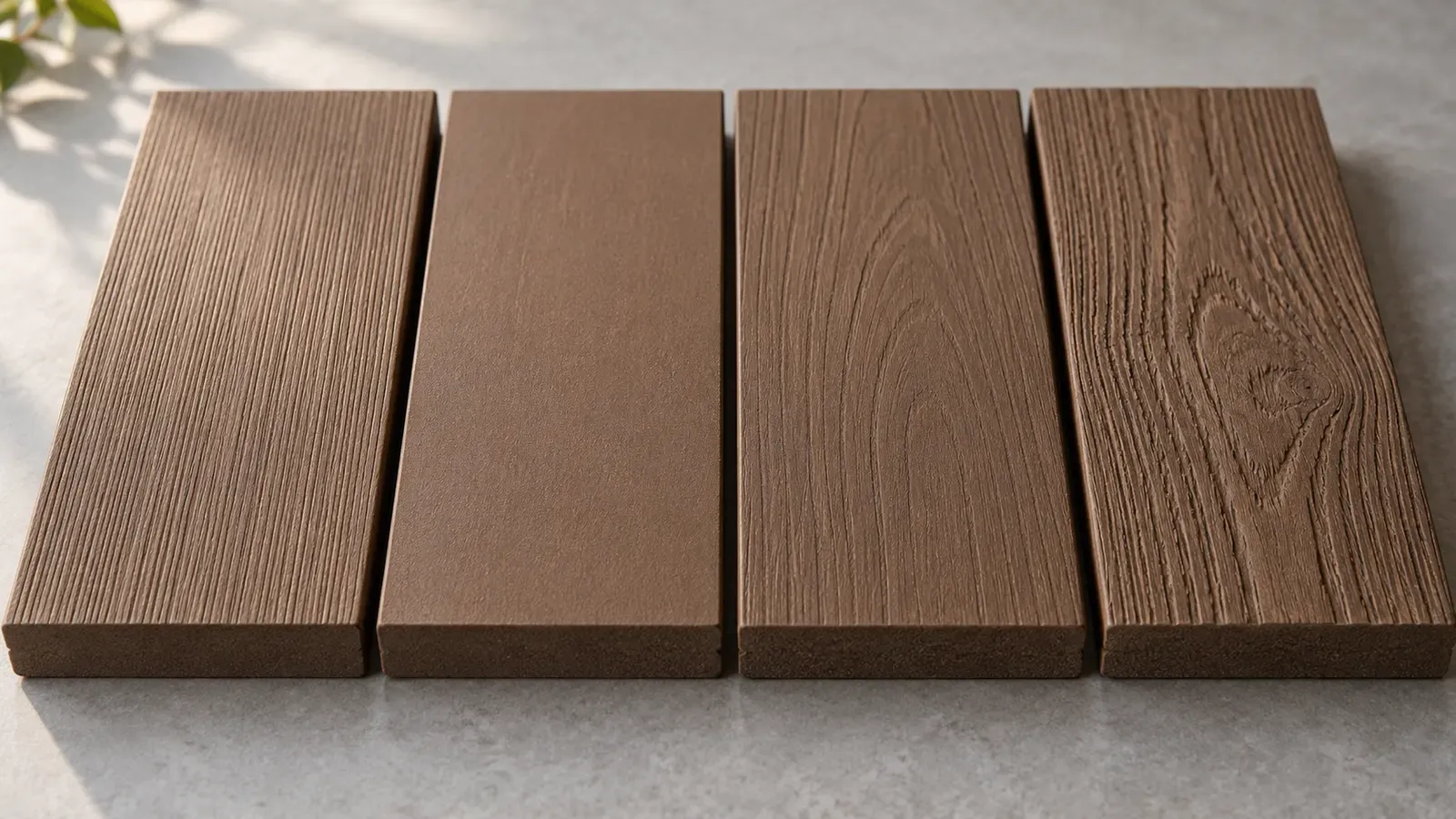
Brushed, sanded, embossed and deep-grain finishes on the same colour.
Step 6: Plan the Substructure and Accessories
The boards you see sit on a frame you do not, and that frame decides whether the deck stays flat.
Joists. Composite boards are commonly laid on aluminium joists, composite joists or treated timber. Aluminium is straight, stable and long-lasting; treated timber is cheaper but can twist and will not outlast the boards. Whatever you use, follow the board’s recommended joist spacing, and reduce it for diagonal layouts and commercial use.
Fixings. Most capped decks use hidden clips that sit in the board grooves and set the side gap automatically. Edge boards and stairs usually need colour-matched face screws.
Finishing parts. Plan for fascia boards to cover the frame, stair nosings, end caps or edge boards for exposed board ends, and skirting where needed. Buying these from the same supplier as the boards keeps colours matched.
See our range of decking accessories.

A straight, well-spaced frame and the right clips keep the deck flat for years.
Step 7: Check Quality Before You Order
Building materials are hard to judge by eye. A board that looks perfect on delivery can fade, swell or crack years later if the formula was cut back to hit a price. Ask for evidence instead:
- Cut a sample and look at the core. It should be dense and even, with no air bubbles, cracks or loose fibre. On capped boards, the shell should be even and firmly bonded all the way round.
- Ask for third-party test reports. EN 15534 is the main European standard for wood-plastic composites, and ASTM D7032 is the North American reference. Ask which tests were run and on which model.
- Ask how each production batch is checked, not only how the product was certified once.
- Read the warranty in writing. Check what it covers (structural failure, fading, staining), for how long, and what installation conditions apply.
- See the factory. Visit, or ask for a live video tour of the production lines and quality control.
You can see how we approach this on our manufacturing and quality page and read our warranty terms.
Step 8: Budget for the Whole Deck
Comparing price per metre of board is the most common budgeting mistake. A realistic budget includes:
- Deck boards, plus a cutting allowance (typically 5–10%, more for diagonal or picture-frame layouts)
- Joists, bearers and footings or pedestals
- Clips, screws and brackets
- Fascia, edge boards, stair parts and end caps
- Labour, or your own time and tools
- Delivery, and for importers, freight, duties and local transport
A cheaper board on a cheap frame is usually the most expensive deck in the long run. Spend first on the substructure and on a board formula you can trust.
Composite Decking Buying Checklist
| Decision | What to confirm |
|---|---|
| Site and use | Sun, shade, water, traffic, climate |
| Board type | Capped or uncapped |
| Profile | Hollow or solid, matched to load and joist spacing |
| Size | Width, thickness, lengths that suit the deck |
| Colour and finish | Samples checked outdoors; lighter for hot, barefoot areas |
| Substructure | Joist material and spacing, fixings |
| Accessories | Fascia, edge boards, stair parts, end caps in matching colour |
| Quality | Cross-section, test reports, batch QC |
| Warranty | Written terms, coverage and conditions |
| Budget | Whole-deck cost, including frame and delivery |
Common Mistakes to Avoid
- Choosing dark colours for a full-sun pool deck. It looks great in the brochure and feels hot underfoot in July.
- Reusing an old timber frame. Old joists are rarely straight or closely enough spaced for composite boards.
- Ignoring expansion. Composite moves with temperature. Gaps set by clips and at board ends are part of the design, not a mistake.
- Buying boards and accessories from different suppliers. Matching colours across brands is close to impossible.
- Judging quality by price alone. Ask what changed in the formula when a quote is far below the rest.
Frequently Asked Questions
What is the best composite decking?
There is no single best board. For sunny, high-traffic or poolside decks, a quality capped board is usually the best choice. For shaded areas and budget projects, a well-made uncapped board can be the better value. The best decking is the one matched to your site, installed on the right frame.
Is capped composite decking worth the extra cost?
For most outdoor decks in full sun or heavy use, yes. Capped boards resist fading and stains better and are easier to clean, which keeps the deck looking newer for longer.
How thick should composite decking be?
Most residential composite deck boards are around 20–25 mm (about 1 in) thick. What matters more is that the board profile and joist spacing match the manufacturer’s guidance for your use.
Does composite decking get hot?
All decking warms up in direct sun, and dark colours get hotter than light ones. Lighter colours and some shade make a noticeable difference on pool decks and other barefoot areas.
How long does composite decking last?
Quality composite decking commonly lasts 20 years or more with basic cleaning, provided it is installed on a sound, well-ventilated substructure. Check the written warranty for the specific product.
Ready to Choose Your Boards?
Samples answer questions that photos cannot. Hold the boards, check the cut ends and compare colours in your own light.
- Homeowners and contractors: Order samples of our decking colours and finishes, or explore our composite decking range.
- Importers and distributors: Request factory pricing for your market.