
Capped vs Uncapped Composite Decking: A Buyer's Guide
Quick answer: Capped composite decking has a protective polymer shell bonded around the core; uncapped decking is one uniform material from surface to core. Capped boards resist fading and stains better and are easier to clean, so they suit sunny, busy and poolside decks. Uncapped boards cost less and have a more natural, matte wood feel, so they suit shaded areas, fencing and value-focused projects.
“Capped or uncapped?” is usually the first technical question in any composite decking quote. The two types can look similar on the day they are installed. The difference shows over the following seasons, in how the surface handles sun, spills and cleaning.
This guide explains what each type is, how they compare in real use, and how to choose for your project. It is written to be practical: neither type is right for every deck, and a well-chosen uncapped board can be better value than a capped board in the wrong place.
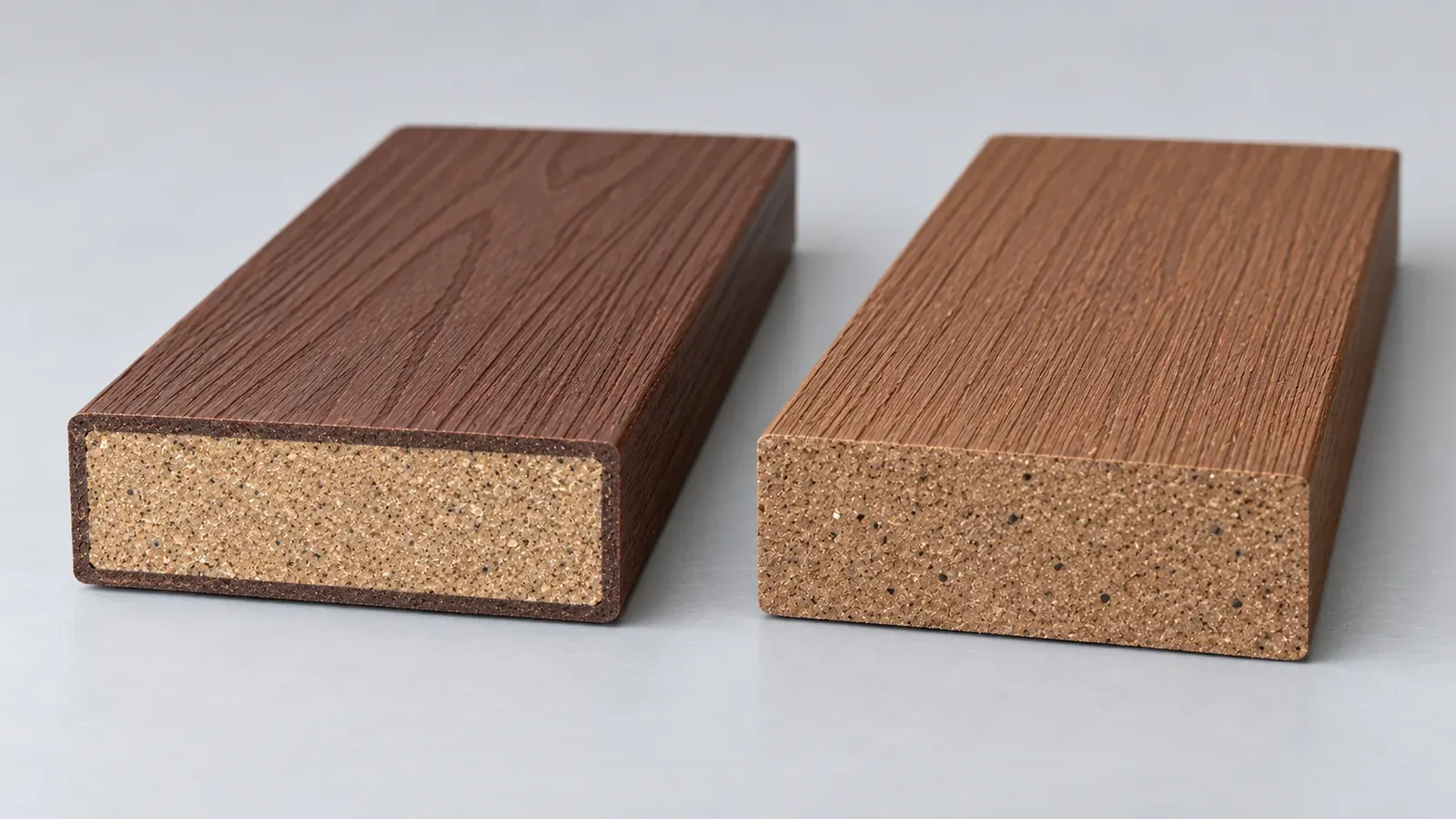
Capped and uncapped boards look alike on day one; the difference shows over the seasons.
What Is Uncapped Composite Decking?
Uncapped decking, often called first-generation WPC, is made from wood fibre, plastic and additives mixed together and extruded into a board. The same material runs from the surface to the core.
Because wood fibre sits right at the surface, uncapped boards have a warm, matte, natural feel. They also absorb a little more water and oil, and their colour changes more in the first months outdoors before it settles.
What Is Capped Composite Decking?
Capped decking, also called co-extruded or second-generation WPC, has the same type of composite core, plus a thin protective polymer shell. Both layers are formed in one production pass, so the shell is bonded to the core rather than glued on afterwards.
The shell is where the factory concentrates UV stabilisers and pigments. It keeps water and stains out of the core and protects the colour. Some boards are capped on three sides; others are fully wrapped on all four (“360° capped”).

The cap is a thin, bonded shell that protects the core from water, stains and UV.
Side-by-Side Comparison
| Uncapped | Capped | |
|---|---|---|
| Construction | One material throughout | Composite core plus protective shell |
| Look | Matte, natural, wood-like | Sharper grain, wider colour choice |
| Colour change in the first year | Noticeable, then settles | Much smaller |
| Stain resistance | Moderate; oil can soak in | High; most spills wipe off |
| Water absorption | Low | Very low |
| Cleaning | Needs more attention | Wash and wipe |
| Slip resistance | Good, natural texture | Good with embossed or grooved finishes |
| Price | Lower | Higher |
| Best for | Shaded decks, fencing, budget projects | Sunny decks, pools, dining areas, commercial spaces |
How They Compare in Real Use
Fading
Almost every outdoor material changes colour in the sun. In our experience, uncapped boards lighten noticeably during the first year, then stay stable apart from surface dirt. Capped boards change much less, because the shell carries extra UV stabilisers and higher-grade pigments. Climate and colour also matter: strong sun speeds up change, and colours made with inorganic pigments hold up better than those made with organic pigments. Our article on composite decking colour variation explains what else affects colour.
Stains and spills
On uncapped boards, wood fibre at the surface can absorb oil, so grease from a barbecue may leave a mark if it is not cleaned quickly. Rinse dust with water and clean oil or ink with hot soapy water as soon as possible. On capped boards, spills sit on the shell and wipe off much more easily, which makes them the safer choice for dining and cooking areas.
Water and mould
Both types resist rot. Capped boards absorb even less water, which helps around pools and in damp, shaded gardens where surfaces stay wet longer. In any deck, good ventilation under the boards and regular clearing of leaves are what prevent mould.
Heat
Capping does not make a board cooler. Surface temperature depends mainly on colour and sun exposure. For barefoot areas, choose lighter colours in either type.
Feel underfoot
Many people love the soft, natural feel of uncapped boards. Capped boards feel smoother and more uniform, and deep-embossed caps can look very close to timber. Order samples of both and walk on them in your own light.

Spills wipe off a capped surface more easily than an uncapped one.
Is the Cap Always Better?
Not automatically. A cap is only as good as its bond and its thickness:
- Too thin, and it can wear through or burst if the core absorbs water.
- Too thick, and the shell shrinks more than the core, which can bend the board.
- Poorly bonded, and it can peel after a few seasons of temperature swings.
Most experienced manufacturers aim for a cap of roughly 0.5–1.0 mm, made with a controlled formula, temperature and line speed. Ask your supplier how they test the bond; boiling and freezing cycle tests on production samples are a good sign.
A well-made uncapped board is a better buy than a poorly made capped board.
How to Choose
Answer three questions:
- How much sun and traffic will the deck get? Full sun, a busy family deck or a restaurant terrace points to capped.
- Will there be food, drink or oil on the deck? Dining and barbecue areas point to capped.
- Is it shaded, low-traffic or a fence? These are where uncapped boards give the best value.
Many projects use both: capped boards for the main deck, uncapped boards for fencing or a shaded side path.
Our Ranges
At SungemWPC, the Shield Series is our capped range, for buyers prioritising a protective surface. The Natural Series is uncapped WPC with deeper wood-grain character, and the Essential Series is a practical first-generation WPC for value-focused outdoor projects. Series names describe the surface; spans, fixings and suitability for specific commercial uses still depend on the profile and the installation guide.
Browse the Shield, Natural and Essential decking series.
Frequently Asked Questions
Is capped composite decking worth it?
For decks in full sun, around pools or in dining areas, usually yes. It holds its colour better, resists stains and is easier to clean. For shaded or low-traffic areas, uncapped boards are often the better value.
Does uncapped composite decking fade?
Yes, more than capped boards. Uncapped boards usually lighten noticeably during the first year and then stay relatively stable.
Can the cap on composite decking peel off?
On well-made boards, it should not. Peeling usually comes from poor production control or a cap that is too thin or too thick. Ask how the supplier tests cap bonding.
Is capped composite decking cooler?
No. The cap does not lower surface temperature. Colour and sun exposure matter most, so choose lighter colours for barefoot areas.
Can I mix capped and uncapped boards in one project?
Yes, in different areas. Many projects use capped boards on the main deck and uncapped boards for fencing or shaded paths. Avoid mixing them side by side in one surface, as they will weather differently.
Choose With Samples in Hand
- Order samples of our capped and uncapped decking.
- Still planning? Read our composite decking buying guide.