
OEM & Private Label Composite Decking: How It Works
Quick answer: Private label composite decking is made by a factory and sold under your brand. You can customise packaging, labels, colours, surface finishes and sometimes profiles, while the factory provides the formula, production and quality control. Start with the factory’s proven profiles in your own colours and packaging, agree specifications and samples in writing, and register your trademark, including in China, before you scale up.
More and more distributors and retailers want composite decking under their own brand. It builds customer loyalty, protects margins from price comparisons and turns a commodity into a product range only you sell.
This guide explains how OEM and private label composite decking works with a Chinese manufacturer: what you can customise, how the process runs, what it typically costs and how to protect your brand. If you have not chosen a factory yet, start with How to Choose a Reliable WPC Decking Manufacturer in China.

Private label means the factory’s quality under your brand.
OEM, ODM and Private Label: What’s the Difference?
The terms overlap, and suppliers use them loosely. A practical way to think about them:
| Model | Who designs the product | What carries your brand | Typical use |
|---|---|---|---|
| Private label | Factory’s existing profiles and formulas | Packaging, labels, sometimes the board | Fastest route to your own brand |
| OEM | You specify colour, finish or profile | Product and packaging | Distributors with a clear range plan |
| ODM | Factory develops a new product for you | Product and packaging | Larger buyers with a new product idea |
Most importers start with private label using proven profiles, then move towards OEM colours or profiles once sales are established.
What You Can Customise
Packaging and branding (easiest)
- Labels, barcodes and product codes on each bundle or pallet
- Printed wraps, cartons for accessories and pallet labels
- Your brand name embossed or printed on the underside of the boards (on suitable profiles)
- Installation guides and warranty leaflets in your language
Colours and finishes
- Choosing from the factory’s colour range under your own colour names
- Custom colours matched to a sample you provide
- Surface finishes: brushed, sanded, embossed, 3D deep grain
Profiles and sizes
- Lengths cut to suit your market
- Width and thickness from the factory’s existing moulds
- New profiles, which need a new die and more volume
Product range
- Matching accessories: clips, screws, edge boards, fascia, end caps
- Matching fencing, cladding and joists for a complete system under one brand
Browse the colours and finishes we can start from on our colours page.
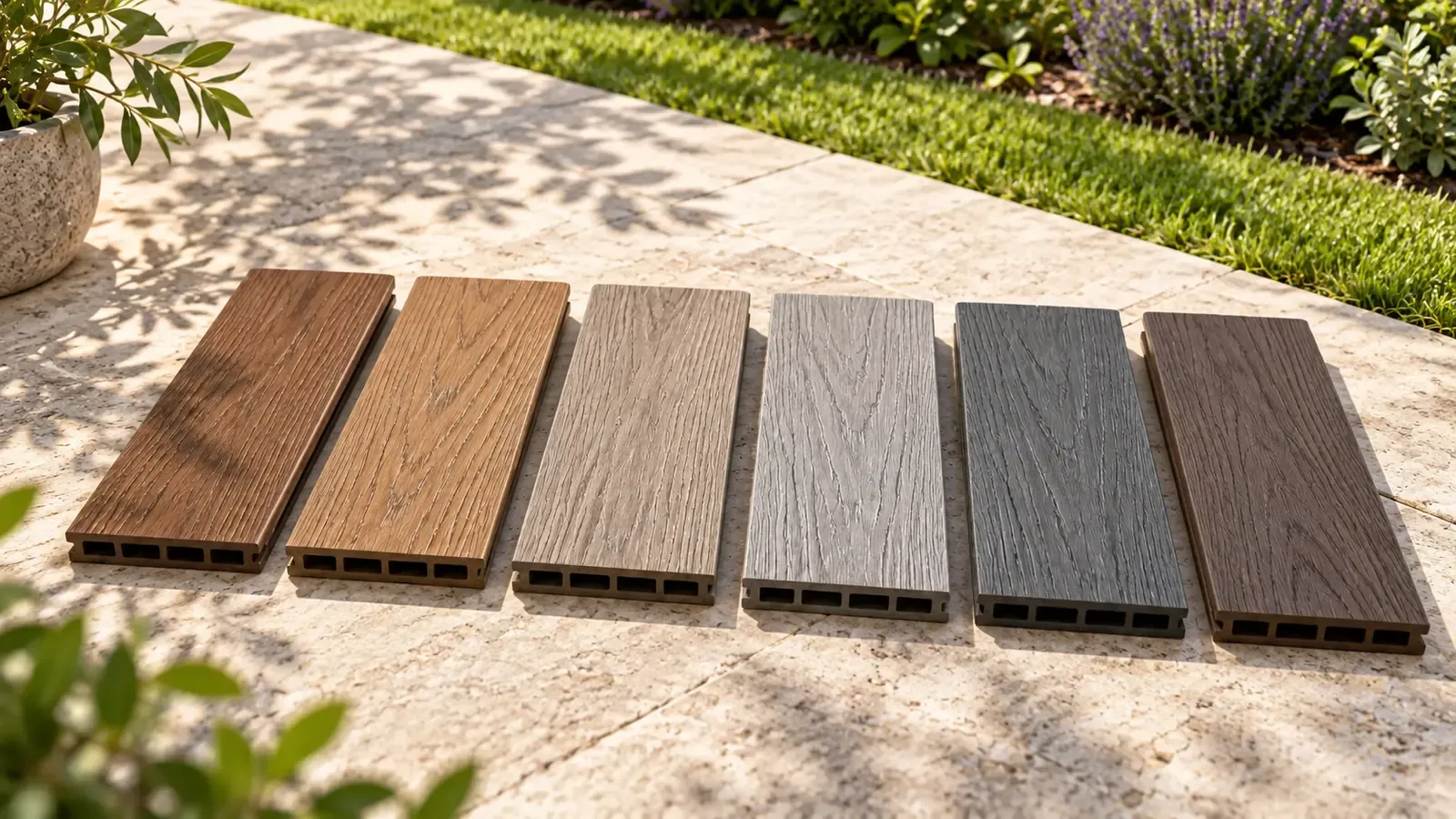
Custom colours are matched to your reference and approved before production.
How the Process Works
- Brief. Share your market, target customers, product range, colours, packaging ideas and expected volumes.
- Proposal. The factory recommends profiles and finishes, confirms what can be customised and quotes costs and minimums.
- Artwork and specifications. You send logo files, label text and barcodes; the factory confirms dimensions, colours and packing.
- Samples. The factory makes samples in your colours, plus packaging mock-ups or photos.
- Approval. You approve samples in writing. Keep a signed set: it becomes the reference for every future order.
- First production. Usually a full container, with photos of the boards, packing and labels before loading.
- Repeat orders. Colour and packaging are checked against the approved samples each time.
Costs and Minimums
Customisation costs depend on how far you go. As a general guide:
| Customisation | Typical cost impact |
|---|---|
| Your labels and pallet marks | Little or no extra cost |
| Printed packaging and leaflets | Printing cost; minimum print runs |
| Underside brand embossing | Small set-up cost on suitable profiles |
| Custom colour | Often a one-off colour development fee, which some factories waive above a volume |
| New profile | A new die or mould, plus a higher minimum order |
Minimum orders are usually set per colour and per order. Custom colours need a minimum quantity because each colour run takes line time and raw material set-up. Expect a full container for a first private label order.
Ask for all one-off costs in writing, and ask whether they are refunded or waived once you reach an agreed volume.
Protect Your Brand
- Register your trademark in your own markets before launch.
- Register it in China too. China uses a first-to-file system, so registering there protects your brand against someone else filing it first.
- Use a written agreement. Cover specifications, quality standards, use of your logo, confidentiality and who owns custom moulds and colour formulas.
- Agree on non-use and non-disclosure. Many importers use an NNN (non-disclosure, non-use, non-circumvention) agreement with Chinese suppliers.
- Keep your approved samples and records for every order.
Quality Under Your Name
When your brand is on the board, every complaint comes to you. Make sure your factory:
- Uses the same formula and quality checks for private label as for its own products
- Tests representative models with independent labs, against EN 15534 or ASTM D7032 as your market requires
- Provides a written warranty you can pass on to your customers, or back your own warranty
- Labels each bundle with a batch number so any issue can be traced
You can read how we approach this on our manufacturing and quality page.
Common Mistakes
- Launching with too many custom colours. Start with three to five colours and add more as they sell.
- Designing a new profile too early. Proven profiles reduce risk and cost.
- Skipping the trademark in China.
- No signed reference samples. Without them, colour disputes are hard to settle.
- Ignoring accessories. A deck brand without matching clips, edges and fascia is hard to sell.
Frequently Asked Questions
What is private label composite decking?
Decking made by a manufacturer and sold under your own brand, using your labels, packaging and often your own colour names.
Can I get custom colours under my own brand?
Yes. Factories can match a colour to your sample. Expect a development fee and a minimum quantity per colour, which some factories waive above an agreed volume.
What is the minimum order for OEM decking?
It depends on the factory and how much you customise. A full container is typical for a first private label order, with minimums per colour.
Who owns the mould for a custom profile?
It should be agreed in writing before production. If you pay for the mould, make sure the contract says it is yours and cannot be used for other customers.
Should I register my trademark in China?
Yes, if you manufacture there. China operates on a first-to-file basis, so registration protects your brand from being filed by someone else.
Build Your Own Decking Brand
We make composite decking, fencing and cladding for distributors who want to sell under their own name.